
Favorite Herbs for Autumn: Supporting Our Inner and Outer Seasons
After five years without experiencing a true autumn, living mostly nomadically, I've been especially grateful to witness the changing seasons here in the Northeast this year.
The crisp morning air, the changing colors of the leaves, the ripening berries, and the gradual slowing of the natural world have reminded me how much I love this season.
As an herbalist, I've also been relishing the opportunity to spend time with the plants that flourish here, gathering and preparing herbs, and exploring the ways they can nourish us through seasonal transitions.
Some of these are herbs I'm wildcrafting during my autumn walks. Others are longtime favorites that I enjoy throughout the year, particularly when I'm craving warmth and nourishment, or moving through the premenstrual phase of my menstrual cycle.
Autumn in Nature, Autumn in the Body
Autumn is a season of transition.
The abundant outward energy of summer begins to recede. Plants direct their energy toward their roots. Trees release their leaves. The light diminishes, temperatures cool, and the natural world begins preparing for winter's rest.
Our bodies have their own seasons, too.
For women who menstruate, the days before bleeding can sometimes carry a similar quality. Often called our Inner Autumn, the premenstrual or luteal phase may bring a shift in energy, greater sensitivity, a desire for more solitude, or a growing awareness of our limits.
Of course, not every woman experiences her menstrual cycle this way, and our bodies don't always follow neat seasonal metaphors. But I've found that observing these rhythms can offer valuable insight into how we care for ourselves.
Whether I'm moving through the autumn months or my own Inner Autumn, herbalism offers me a beautiful way to practice that kind of deep listening.
Here are a few of the plants I've been enjoying lately.
Hawthorn
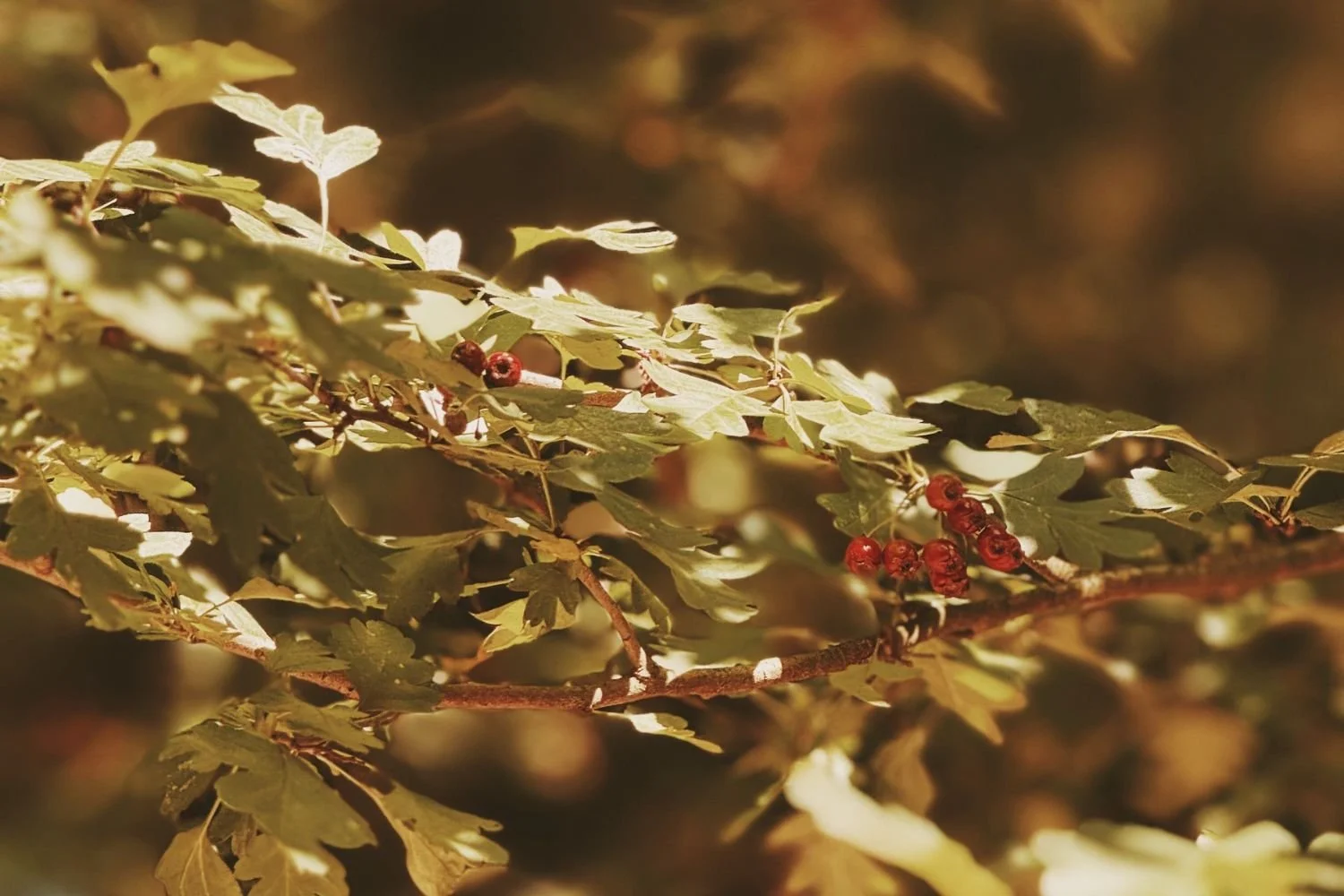
One of the plants capturing my attention this autumn is hawthorn (Crataegus spp.).
In spring, hawthorn trees are covered in delicate white blossoms. By autumn, those flowers have transformed into clusters of brilliant red berries.
I love plants that make the passage of time visible like this.
Hawthorn also has a long history within Western herbal traditions, particularly as an herb associated with the heart and emotional well-being. Beyond its traditional uses, there is something about hawthorn that feels especially appropriate for autumn to me: protective yet soft, thorny yet generous, holding bright red fruit as the rest of the landscape begins to fade.
I've been gathering hawthorn berries during my autumn walks and deepening my relationship with this beautiful plant, one of my favorite parts of practicing herbalism.
Red Raspberry Leaf
Red raspberry leaf (Rubus idaeus) is probably best known as a women's herb, toning the uterus and supporting the female reproductive system.
The leaves contain minerals and tannins and have a pleasantly astringent quality, making raspberry leaf one of the herbs I enjoy incorporating into nourishing tea blends.
This autumn, I've particularly enjoyed gathering healthy raspberry leaves before the plants become dormant for winter.
I also return to raspberry leaf during my inner autumn. It's a simple, earthy plant ally for the days when I'm naturally paying a little more attention to nourishment, rest, and the needs of my body.
Sometimes the most supportive herbal practices aren't elaborate formulas. They're a jar of dried leaves, hot water, and ten quiet minutes.
Ginger
Ginger (Zingiber officinale) has long been one of my favorite warming herbs, regardless of where I happen to be living.
Its unmistakable pungency and warmth make it especially lovely during cold, damp weather. I enjoy slicing fresh ginger into a decoction (boiling hard plant parts like roots and bark to extract their medicinal compounds), adding it to soups and broths, or combining it with other aromatic spices.
It's also one of the herbs I often reach for around menstruation or premenstrually to help with bloating. Ginger has a long history of traditional use for digestive discomfort, and research has explored its potential to help ease menstrual cramps.
Mostly, though, I love the felt experience of ginger: warming from the inside out.
Whether I'm experiencing a chilly autumn day or simply craving a little warmth and comfort, ginger is often one of the first herbs I reach for.
Cinnamon
Cinnamon (Cinnamomum spp.) may live in the spice cabinet rather than the herb garden, but its warming, sweet, aromatic qualities make it a natural companion for autumn.
I love cinnamon in herbal teas, nourishing breakfasts, and slow-simmered dishes. It pairs especially beautifully with ginger.
It's also a spice I enjoy during my premenstrual phase, when I often feel drawn toward warm, comforting foods and a little more slowness. It supports steady blood sugar, which tends to swing more during the luteal phase.
Try adding a cinnamon stick to a pot of ginger decoction or including a small piece of bark in a longer herbal infusion.
Rosehips
If we're talking about autumn herbs in the Northeast, rosehips (Rosa spp.) are an absolute must.
These jewel-like red fruits develop after the rose blossoms have faded and become increasingly noticeable as autumn progresses. There is something particularly beautiful about rosehips at this time of year. Summer's flowers are gone, yet the plant is still offering something.
That feels like one of autumn's teachings in itself: transformation isn't always loss. Sometimes what comes after the bloom has its own kind of nourishment.
Rosehips have a tart, fruity flavor and are traditionally enjoyed in teas, syrups, and other herbal preparations. They're also known for their vitamin C content, although the amount retained varies with processing and preparation.
I especially love the idea of pairing their bright, tart flavor with warming spices like cinnamon and ginger.
Oatstraw
Finally, oatstraw (Avena sativa) is an herb I return to throughout the year, but its gentle, nourishing qualities feel particularly appropriate for this season.
In Western herbalism, oatstraw is traditionally considered a nourishing nervous-system tonic. I enjoy preparing it as a long infusion, allowing the dried herb to steep for several hours or overnight.
I appreciate oatstraw because it reminds me that herbalism isn't always about treating symptoms. It can also be about tending ourselves consistently, offering our bodies nourishment, warmth, sensory pleasure, and moments of pause. A long oatstraw infusion feels like exactly that.
A Simple Autumn Herbal Ritual
You don't need an elaborate apothecary to practice seasonal herbalism.
Choose one plant.
Make yourself a cup of tea or overnight infusion.
Sit somewhere without your phone for ten minutes. Notice the warmth of the mug in your hands, the aroma of the plant, your breathing, and how your body actually feels today.
Then ask: What is this season asking me to tend, nourish, or let go of?
This is one of the places where herbalism, body awareness, and seasonal living meet for me.
The plants are part of the practice, but so is learning to notice.
Living With the Seasons
After spending many years in places where the seasons aren't marked by the same dramatic changes, experiencing autumn again has felt particularly meaningful.
It's reminded me yet again how deeply connected our bodies are to the natural world, even when our environments and lifestyles don't follow the familiar rhythm of four distinct seasons.
One of the reasons I love herbalism is that it continually brings me back into relationship: with the plants growing around me, with the landscapes I find myself in, and with my own body.
Autumn reminds us that we are not meant to remain in perpetual summer. There are seasons for expression and expansion, and seasons for drawing inward. Seasons for flowering, and seasons for gathering what has ripened. Seasons for holding on, and seasons for letting go.
Our bodies have their own rhythms, too.
Sometimes we simply need to become quiet enough to hear them.
Curious about the seasons of your own body?
My free Cycle Tracking Starter Guide is a gentle introduction to observing your body's rhythms, including changes in energy, mood, physical sensations, and needs throughout the month.
Download the free Cycle Tracking Starter Guide →
Herbal information shared here is for educational purposes and is not medical advice. Always positively identify plants before wildcrafting, harvest responsibly, and research herb safety, especially if you take medications, are pregnant or breastfeeding, or have a medical condition. Hawthorn in particular warrants professional guidance when taking cardiovascular medications.
About Ebb & Flow: Ebb & Flow is the holistic women’s wellness practice of Emma Brinkman. Through herbalism, menstrual education, women’s mentoring, somatic practice, and feminine ritual, Ebb & Flow works to connect women to the power and wisdom within their bodies, in order to live more easeful, sensual, vibrant, and empowered lives. Follow along to stay up-to-date on blog posts and articles, and check out all of Emma’s offerings, which include 1:1 mentoring, monthly online women’s circles, online courses, and custom ritual guidance for navigating life’s transitions.
